The Single and the One: A Conversation with Kierkegaard
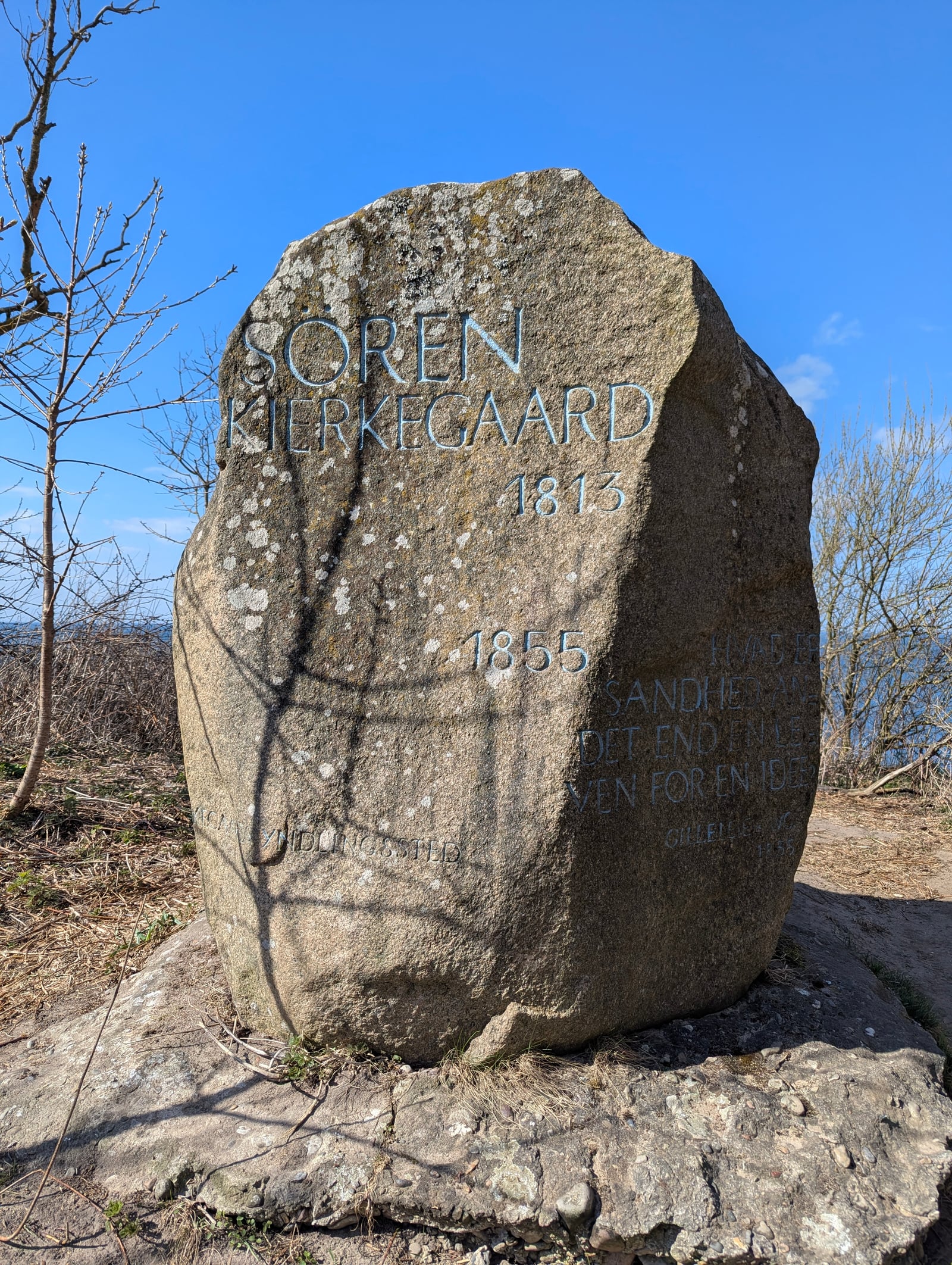
I. Gilbjerg Hoved Cape
At Gilbjerg Hoved, the northernmost point of the island of Zealand, Søren Kierkegaard was visited by thoughts that became the foundation of his philosophy. On August 1, 1835, in Gilleleje, at the age of 22, he wrote in his diary:
Now, nearly 200 years later, standing at the same spot, breathing the same cold sea air, gazing into the boundless northern waters of the Kattegat strait, I conclude:
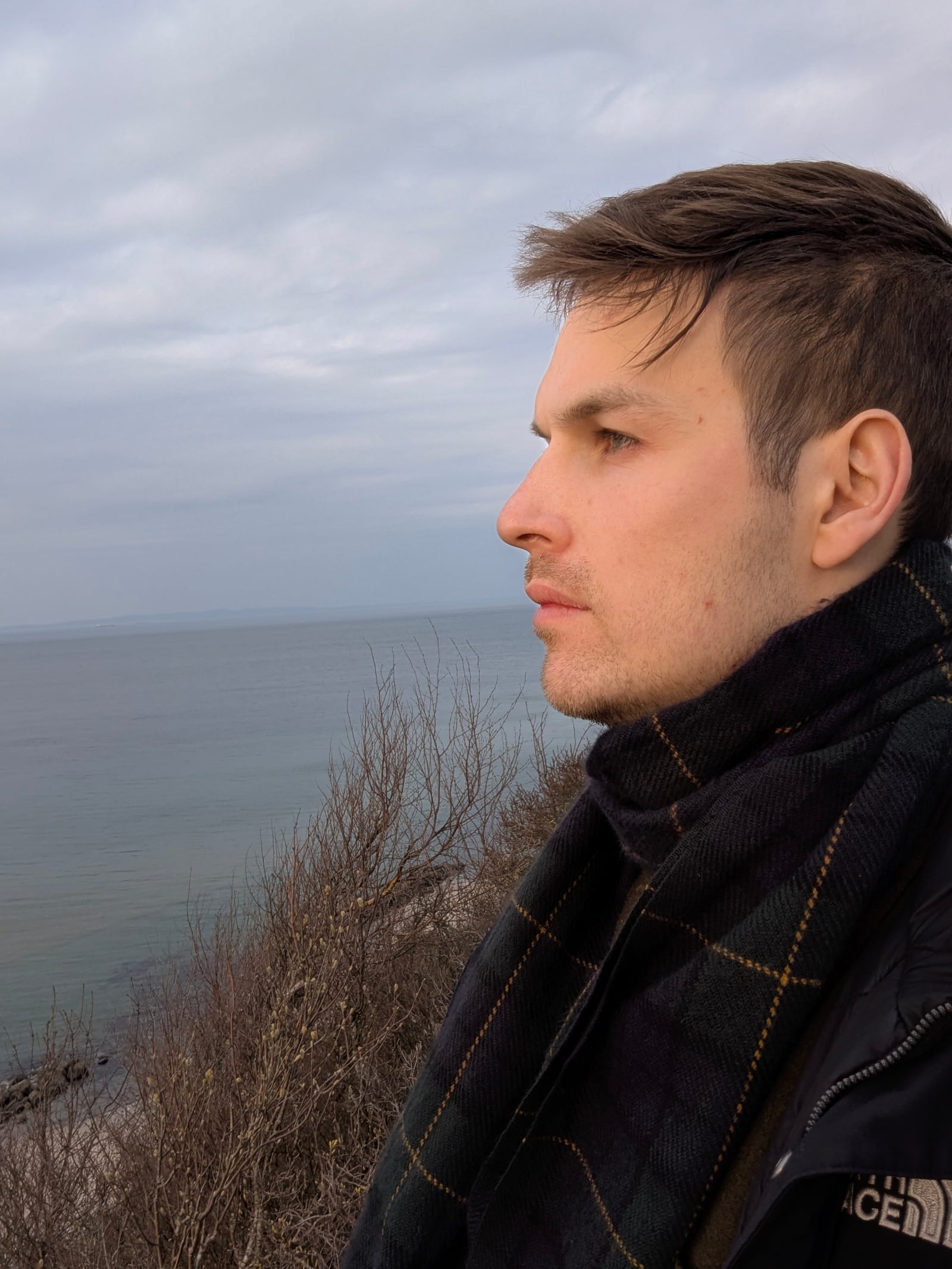
Kierkegaard, in his genius, was more than 50 years ahead of Western thought, realizing that personal experience is, for the human being, the center of his life. He vigorously mocked any claim by any person or institution to pass off the subjective as objective.
Kierkegaard proclaimed that a person’s life consists of his own experiences, which are shaped by his attitude toward what is happening. And that these experiences cannot be described logically, refuted, or proven; they cannot be known rationally. Thus, he came to the conclusion that human life is essentially irrational, and there can be nothing objective in it. Life is passion, not logic. And Kierkegaard was full of this passion!
Passion, desire — this is the energy of life. It is like light passing through the kaleidoscope of our beliefs, creating the marvelous mosaic of our life.
Kierkegaard saw this. He was aware of himself as uniquely existing, and that his existence is defined by his own meanings. But even he remained inside the kaleidoscope of his deepest convictions, accepting them as the givens of Life.
Carrying these cornerstones within himself, he found himself in the very situation he had mocked about in regard to other philosophers. He came to believe that his sufferings and his philosophy of life were of a fundamental character. This is reflected in his diaries, where he wonders why others do not share his profound experiences:
But do such givens really exist — ones from which “the stones should weep”? Is it true that every person’s lot is to live through existential anxiety, despair, lostness, and suffering?
For a long time, I myself thought so. I lived through Kierkegaard’s sufferings. I passed through meaninglessness, lostness, total loneliness, and existential despair, and I too arrived at the absurd.
II. The Turn Inward
It seemed to me that this was objective Reality, the givens of existence. As I matured, I discovered that these were not givens, but consequences of my personal beliefs. And that it is precisely they, and not the events of life in themselves, that shape my life experience, making me happy or unhappy. (1)
Then, over a long period, through psychotherapy, introspection, and reflection, I unfolded these beliefs within myself, bringing them from the unconscious into awareness. In this process, I discovered that these notions had not come to me from nowhere — they had been passed down to me “by inheritance” from the culture in which I grew up. And that I myself could choose different ones! (2)
So I set about consciously rebuilding my worldview. The hardest work for me was with beliefs about myself, my identity. First and foremost — because of the enormous amount of inner pain and suppressed feelings that I had long kept away from my consciousness.
It was difficult and painful. Time and again I came into contact with the deepest truth within myself, with my most sincere sensations. But the more I went into myself, the more I touched my sufferings, the easier it became. They seemed gradually to discharge, to be transformed into some other kind of energy. It became easier to feel myself, because it no longer hurt as much. Over time, I began to notice that from negative feelings — anger, fear, guilt, shame — I was moving toward positive ones — compassion, gentleness, acceptance, peace, and even gratitude. (3)
Along with new feelings, my beliefs began to change as well. I worked on myself on two planes: on the level of the mind, I rethought what I believed, so that it would more accurately reflect my inner truth. And on the level of the heart, I established contact with my feelings, living through and transforming inner pain.
The heart, which had been closed off from pain, opened up and became softer. I felt happier; life filled with new meanings. The volume of suffering was still great, but it no longer caused despair. On the contrary, suffering became for me an instrument of inner truth — wherever it hurt, there I saw my true self, and I used such moments to make contact with myself at the level of the heart. (4)
But in time, I felt that I had reached the boundaries of the rationally knowable world. Over 7+ years, I studied and tried a great deal of what the natural sciences, psychology, and philosophy had to offer me. I even went further and embraced feelings and values that lay beyond the bounds of pragmatics and the formal systems of human knowledge. This enriched my world, but it was not enough for true self-determination. Not enough to confidently answer the question of who I am. I still felt that I was missing something extraordinarily important.
III. The Step Beyond
I stood at its very edge, perhaps as Kierkegaard had stood physically on Cape Gilbjerg Hoved. Standing at the very edge. All the land behind me trodden, every path walked. Beyond — the sea. Its spray was already moistening my face — a subtle intimation, the deepest feelings in moments of contemplation and immersion into my own heart. And here I decide to take just one step forward. Not knowing what is there, in the water. Letting go of the firm earth beneath my feet. I acknowledge — the land is no longer enough. With all my outward well-being, all my knowledge and skills — I am at a loss. I am at an impasse. This is still not enough. I am not enough. The emptiness remains. Can I ever feel true fullness? Does such a thing as Truth exist? Can my emptiness become fullness? And so I lift my foot and take the step. Utterly naively, utterly sincerely, I say the words: “God, if You exist, set me upon the true path. I am lost. I need help.” And… Silence. Nothing happens. I go to sleep.
The next day, as was my custom, I plunged deep into myself, to the level of the heart. That day I was asking only one question — what do I want? What is my true desire? (5) And I heard myself — my deepest desire is to love and to be loved. In that moment I felt an entirely new experience, one I had never known before. It kindled like a small flame within me, and I felt myself to be a tiny particle, torn away from my native place, yet with the clear awareness that I would surely return home. (6) And then I inwardly allowed — what if I am a soul, a particle of God, and home is God? As soon as I accepted this supposition, I felt myself infinitely small before the infinitely great, and my world turned upside down — I felt an inexhaustible unconditional love directed toward me; I felt myself utterly transparent to it. And then there remained neither me as the infinitely small, nor God as the infinitely great. Love filled everything, and there was nothing but love. I felt myself Home. It felt like a remembering and a recognition of what had always been. And this was God.
This deepest spiritual experience, the most overwhelming of my life, became a revelation. I was stunned. I was amazed. (7) I could not have foreseen it. I stood on the cliff before the sea. I took a step. And instead of drowning, I walked on water. What was rationally impossible took place, but faith the size of a mustard seed (Matthew 17:20, Luke 17:6) made it possible. This was the very leap of faith that Kierkegaard describes — the passage from the rational into the irrational. In my case it was not even a leap, it was a step. And that was enough. Because on the other side there was not emptiness, but a living, radiant fullness that answered a thousandfold. It was a living encounter of two hearts, and at the peak of the experience — their complete unity. And the whole world came alive, became imbued with spirit. Life acquired fullness, I acquired wholeness. I lived through the deep happiness toward which I had so long striven. (8)
After this, my old conceptions of myself and of the world weakened. Having lived through an experience beyond their bounds, I saw them as illusions. For the reality they created turned out, for me, not to be the final one. The final reality for me proved to be the one I encountered upon making the leap of faith. (9)
Then followed a period of the wholesale demolition of my old “I” and the creation of a new one. And once again it was painful. The new was qualitatively different from the old. Within a few weeks, the inspiration of love dispersed, and I felt the sharpest contrast. The same emptiness as before, only now with the memory of an alternative. I felt myself like a calf torn from its mother’s udder, deprived of milk. There came a period of separation and grieving lasting several months. I felt forsaken, abandoned. (10)
I did not want to live in the old way, but I did not understand how to live in the new way, how to live spiritually. I tried to find paths in religious literature. The transcendent experience helped me grasp instantly much of what was written, but my mind stumbled over the numerous contradictions of various interpretations and different traditions. I could not bring it all together into one.
The only thing I had left was faith. Faith that this was possible. Because it had already happened for me. And when I focused all my intention upon the certainty that it would happen again if I asked for it, I once again turned to God with the same request. And then I very quickly began to come across information from completely different places, and the fragments came together into a single picture. And once again — recognition: here it is! I had at last assembled a non-contradictory worldview, one that reflected my revelation and answered my questions about the spiritual life.
This became my highest understanding, the one that best expressed my inner truth. And I began to create myself and my experience after this new image and likeness (11). I once again came to live a full and beautiful love. But now, in my life, it exists not as occasional earthquakes, but as light… the source of which is myself.
Now I see which conceptions lead to suffering, and which to happiness. Which are based on fear, and which on love. I have the experience of both, and now at last I create my own experiences through deciding and choosing what I believe in. For I know that belief creates my experience. And I choose that belief, those conceptions, whose experience more accurately reflects my highest understanding of who I am. (12) This can be described as follows:
IV. The Mythology of Suffering
Kierkegaard truly suffered desperately in that life (existence) which is the product of his basic beliefs. So strongly that his consciousness was itself unbearable to him:
Upon what foundations does this world, full of loneliness and suffering, rest?
Kierkegaard was born into an extremely religious family. Kierkegaard’s father carried within himself a profound sense of guilt and believed that his family was cursed because, as a child, he had cursed God. In this spirit of “condemnation prior to any deed,” he raised his son, instilling in him a sense of unconditional guilt and sinfulness before God. As he matured, studying philosophy and theology, Kierkegaard’s sense of guilt grew into a sense of duty, and afterward he continued to build his relationship with God on this foundation.
There exist conceptions that lead to suffering (13). I see them in Kierkegaard. They were passed down to me by inheritance as well. Human culture is built upon them, especially Western culture. I chose Kierkegaard for examination not by chance — in him I recognize myself as I was before my existence was transfigured by the experience of the divine. And in him I recognize the collective image of Western thought, its theology and philosophy.
Now let us examine each of these conceptions in detail. How they manifest in human culture, and how they were lived through by me and by Kierkegaard. At times I will call them illusions, and this is not accidental. Any conception beyond which we step in the moment of consciousness’s expansion begins to be perceived by us as limited, inaccurate, or untrue. And those conceptions that will be described below became such for me too, after experiencing what lay beyond them. I clearly saw that they do not exist on their own, but are created and sustained by our mind.
These are our own constructs. But nevertheless, the experience generated by them is felt by us as quite real. This is an important distinction — our experience is always real for us, even when our conceptions of Reality are incomplete. And the broader our conceptions, the broader our experience. The more our reality contains Reality as such. But it all begins with the experience of what, in Reality, I am not.
Need
The first thing that appears in me as a sensation different from who I am in Reality is the feeling of my own incompleteness. I suddenly begin to believe that I need something, that simply to be is not enough. I suddenly came to believe that I am not what I AM — that my “I-am-ness” is less than it is in Reality. And consequently, I cannot be satisfied and happy as I am. Moreover, for life, I too suddenly begin to need something. Now that I and my life are not complete as they are, I cannot simply live, I cannot simply be. Life becomes survival, and I, instead of being self-sufficient, become self-surviving.
Now I have to take care of meeting my needs. At the deepest, sometimes not always conscious level, there is a feeling of insufficiency and dissatisfaction: with myself, with other people, and with life in general. I live by an imperative — I absolutely must be someone, otherwise I am no one!
Even when I am well-fed, healthy, and in comfort, anxiety appears. This anxiety is caused by the belief in my own incompleteness, the fear of “nobody-ness.” This anxiety launches a search for what I am still missing. And I find it! I always find it. And again I experience dissatisfaction until I obtain it. And when I obtain it, I rejoice briefly, until I begin to feel anxious again, and so on without end. Because such is the very nature of incompleteness — to strive for fullness, yet never attain it.
In Kierkegaard, this is sewn as a fine thread through all his philosophy: in the aesthetic stage, the need for pleasures (14); afterward, in the ethical stage, the need for duty and discipline (15); and finally, in the religious — the need for God, which Kierkegaard rates as the highest (16). And yet, the very basic conception of need is accepted by Kierkegaard as an objective given of human existence.
To see more clearly how this manifests in his inner world, let us return again to the surroundings of Cape Gilbjerg Hoved, this time to the fishing village of Gilleleje, where Kierkegaard underwent his initiation into adulthood away from the family nest. There, on his solitary coastal walks, were born the following lines, in which the depth and force of this need is expressed in poetic form:
This is not merely a longing for an inner living truth. Here this longing, this inner striving, the directedness of every life toward its core, toward the soul, is tinged with the belief in a colossal neediness. A belief that gives rise within to an enormous vacuum that demands filling. A vacuum that cannot be filled either by pleasures or by moral duty. With which one is left only to coexist through blind faith as resignation to the absurdity of this existence.
But at some point, as I went deeper into my experiences, something within me awakens. (17) At first as a light intuition, but over time shining brighter and brighter. What is this light? Is it hope? Where does this certainty come from that it can be otherwise? I do not know. I cannot explain it. But I know for certain that it exists. It becomes an intention, then a firm faith. And then, one day, a flash, an illumination. And I feel — I AM, and that is enough! (18)
Failure
But still, when I believe I need something, I begin to try to fulfill the need. And this does not always succeed. And even when it does, a new need appears too quickly. Thus I begin to believe in the possibility of failure in my striving. This gives rise to fear. What was previously background anxiety becomes terror. I CAN FAIL! I can lose definitively. I can remain forever incomplete — a no one.
And I am squeezed between the dissatisfaction of need and the fear of failure. The first pushes toward action, the second stops it. Risk appears. To live becomes risky, life turns into an unceasing drama.
Kierkegaard believed that only under such risk does choice become authentic. The conception of failure is accepted by him as a given of existence. Without the possibility of failure, Kierkegaard feels that suffering loses its weight. To this he is not prepared to consent — sufferings form his identity, sufferings are the meaning-shaping framework of his world. Consciously or not, Kierkegaard continues to direct his life in the dramatic genre:
But over time I grow saturated with this scenario. I tire of judging myself by the category of failure. And then I discover that all criteria are external, in one way or another adopted by me from outside. And further, even if I myself set them, I understand their relativity. I turn my gaze upon the world without evaluation, and I see: Life itself contains success within itself, simply by the fact of its occurring. I look at the growing pines and see in them no failure — neither in the tall ones nor in the short ones. I look at flower beds, ones already wilted and still blooming, and even the ones not yet opened, and I see them all perfect just as they are here and now. I realize: the world, prior to my judgments about it, is successful and perfect in itself. And finally, I look at myself without judgments and see the same thing! The perfection of the process becomes a given of my existence.
Separateness
And when this does not happen, I begin to sense that defeat is impossible in itself. That someone or something is needed, to whom or to which I lose. I sense that for failure, an alternative to success is needed, something that would exist apart from what already is. And so in my consciousness arises a division: good and evil, victory or defeat, success or failure, life and death, I and not-I. I begin to believe in my separateness from Life, I begin to believe in not-Life. The fear of death, of non-being, appears. (19) And if death is total separateness from Life, then the same separateness of self from non-self on the outside, from others — is loneliness.
But loneliness was not enough for me. Consciously or not, I decided to live separateness to the maximum. Along with separating and distancing myself from others, I separated myself from myself, I saw a not-self within. I divided myself into parts and considered them not me, but something else, alien. I denied those aspects of myself that I did not like, and I resisted them. I did not trust myself, I denied myself. It was so strong that I felt neither myself nor Life — as if I lived behind glass, in my inner detachment. A sharp mind became my chief assistant in maintaining this glass; it was easy for me to imagine myself in this way.
Kierkegaard too had a sharp mind. His conception of separateness was no less strong than mine. The separation of self from Life can be traced in his works “The Concept of Sin” and “The Sickness Unto Death,” described as a rift/abyss between the finite and the infinite, the human and the divine:
In addition to estrangement from God and from one another, he felt an acute personal isolation and the impossibility of being understood, from which he derives the thesis that we are in principle incapable of understanding one another’s subjective world. These experiences were his reality, as they had once been mine:
The seemingly insurmountable abyss between oneself and others also gives rise to a feeling of otherness, the sense of being an “exception” or a “black sheep”:
Kierkegaard, like me, not only separated himself from Life and from others, but also separated himself from himself, generating an inner separateness. He designates this as despair — the deep experience of the absence of one’s own wholeness.
Such self-exclusion gives rise to acute apartness, but it also makes it possible to fully feel one’s individuality. Without separating oneself from the Whole, it is impossible to enter into relations with It, just as it is impossible to enter into relations with one another. I as a subject begin where another ends as a subject, even if these boundaries are constructions of my mind. Therefore, relations with oneself also begin with the loss of wholeness — this makes it possible to single out each of one’s aspects for their detailed examination and experiencing.
Such is the nature of the mind — separation from the Whole. And as long as I remain within the bounds of the rational (ratio — share, proportion, relation), I will always find myself in a world of shares and relations. (20)
Having walked many times along all the pathways of the mind, having examined the world of the rational in every possible variation, I understand that it is exhausted. The experience of singling out, separating, fragmenting myself and the world around me does not allow me to feel my wholeness. No matter how many connections and relations I construct with my mind, this is not equal to the experience of Totality; these are still only its finite aspects. (21)
And even if I do not realize this, somewhere deep within myself I feel that there is a world beyond, that further expansion is possible. Leaving rationality behind, following only my deepest feeling, I turn to God in words exactly as I sincerely feel. By this address, I acknowledge my limitedness and the existence of the Greater. I do what Kierkegaard proclaims to be the cure for despair — the leap of faith:
And on the next day, when I once again plunge into myself, I live through transcendence as the experience of boundless unconditional love. At the peak of the experience, all boundaries dissolve and only Love remains — the experience of total Oneness. (22)
From this vantage, separateness from a given becomes a choice. And I choose to believe in Oneness.
Lack
Except for those cases when I do not choose. And then I think the following: if Life is fragmented, then I may not have access to its other fragments, in the need for which I believe. I may not have enough — no, I already don’t have enough of what I need! Now I am not merely surviving, but surviving in a world where there is not enough of everything. Under such conditions, the chief force of life for me becomes the instinct of survival. I even believe that people unite not out of love, but for the sake of survival and more successful competition with others. Constant competition becomes a necessity, for there is not enough for everyone. I know this for certain, because I myself do not have enough!
And I lack much: time, money, abilities. Attention, recognition, respect. Anything I see that another has but I do not — and there it is, I already lack it. (23) Living by the conception of separateness, I was an efficient device for converting the abundance of Life into personal lack. This is accompanied by experiences of fear, stinginess, anger, envy, and even jealousy. And the more strongly I feel the lack, the more vivid the palette of the feelings listed above.
In Kierkegaard’s consciousness, the conception of lack is present as a cornerstone of the human being — it is a vacuum, the consequence of the rift (the belief in separateness) between the human (the finite principle) and that which he strives to become — the eternal principle, the Absolute. According to Kierkegaard, the result is Homo sapiens (rational man), reaching toward Homo deus (divine man) without the possibility of overcoming this rift by his own powers, for the difference between the finite and the infinite is incalculable. It is not quantitative, but qualitative.
Consequently, no matter how much is done, all of it is calculable and finite, and does not lead to eternity. Such is the conclusion, an absolutely logical conclusion, that follows from the belief in separateness, failure, need, and lack.
And the best one can hope for, proceeding from these convictions, is to become aware of oneself as the irreconcilable tension of these opposites. Loving irony and using it to accept his existence, Kierkegaard calls such a position of tension, of inner unresolvable contradictoriness, by the Danish word Hvile — repose.
The only thing that sustains him in this position is the faith that even despite separateness from God, a connection with Him is still possible. By means of faith, a person can still stand in relation with God, which for a person means to be in true relation with oneself. Such a relation Kierkegaard calls the Ground, or the Self. Here Kierkegaard creatively employs the conception of separateness so that, feeling his full limitation and bounded apartness (in his terms it will be Den Enkelte, the single individual) from Being, he might enter into sincere and full-fledged relations with It:
And here he acted ingeniously, for with a complete renunciation of the conception of separateness, it is impossible to feel oneself as a single individual, and therefore impossible to enter into full-fledged relations. The whole problem begins where separation, from a creative instrument, turns into the cause and given of my existence. And there is nothing one can do with givens, they are what they are. So, from a free creator I turn into a hostage of my beliefs, having forgotten that I myself built my prison.
And what I lacked most in this prison was love. To realize this deficit was the hardest thing of all for me. It was such a deep, such a painful fact of my reality, that to come into contact with it was tantamount to crucifying myself. And nevertheless, I arrived precisely at this. This step required enormous inner honesty and the acceptance of my vulnerability.
And it was even harder to see that this is not a need, but a desire. Deep and sincere, the kind that moves everything in my body. The kind that, even if mediately, sets all of my life in motion. And focusing on it, I begin to notice that love, from a desire, becomes an experience when I directly express it, when I love… I discover myself to be the source of that in which I had imagined a lack. And the more I pour forth, the more I possess. (24) Abundance becomes a new given of my existence.
Requirement
When I live from a feeling of inner fullness, I am obligated to nothing. Just as a spring of fresh water gushes forth from overflow, I live by pure desire and the spontaneous expression of my nature — creatively, playfully, freely, and joyfully. Otherwise, my life is weighed down by the necessity of filling an inner emptiness. Spontaneous expression is replaced by actions aimed at concrete results, in order to obtain what is lacking. And to guarantee receiving it, I begin to impose requirements. My desire becomes encrusted with expectations, and I begin to create or adopt rules by which, as it seems to me, I must achieve these concrete things.
Of course, far from all the types of deficiency and ways of covering them are known to me, so I simply adopt many of them from other people. In this way I begin to feel that I am not living aimlessly, that I am solving important tasks, that I am responsible/moral/good or some other such thing. I fill my life with goals, obligations, requirements, and rules, not only so that my life might gain meaning, but also so as not to feel my own “nobody-ness.” And to some extent this works. I identify myself with my profession, with the social role of friend / parent / partner / or whatever else, depending on which specific role’s expectations I meet.
In Kierkegaard’s consciousness, requirement took the form of duty. This was a consequence of the sense of unconditional indebtedness inherited from his father, which, as he matured, grew into the feeling that there is something fundamental that “I must do.” Thus duty becomes for Kierkegaard the engine of the human being on the ethical stage. Later, through duty, he interprets the relationship with God on the religious stage, and he also uses duty as a key concept even for interpreting love in his later works:
Thus, Kierkegaard wraps the freedom to love in the form of an obligation, for only in this wrapping, according to Kierkegaard, does it acquire stability. And this is not accidental. For we are capable of being with God only in such relations as we are capable of being with others and with ourselves.
For Kierkegaard, the figure of God was for a long time his father. His father had begotten him physically, his father had given him morality and basic convictions: need, lack, separateness, the belief in failure. From his father came all the requirements and rules. And condemnation was reinforced by punishment for non-compliance. Therefore, such was the love known to Kierkegaard — exacting, judging, conditional… Which became the basis of his relationship with God and his interpretation of the nature of love as duty, in which he tried to give it support. Perhaps just as he had once tried to give love stability in his relationship with his father.
And everything seems more or less fine, except that with such an existence, the inner emptiness remains. Insufficiency is never replenished completely. There is always some kind of anxiety — “something is lacking.” And my anxiety sharpens as soon as I stop. Therefore, I absolutely cannot stop. I must do even more, try harder. Then I will surely fill this emptiness… From a human being I turned into a human doing.
And I very intensely lived myself as a human doing. I managed to turn requirement into personal meaning, and its satisfaction into a source of value. I defined productivity as the highest value, as the way to fill this deep dissatisfaction. Efficiency became the criterion of life. And still this did not make me happy. It was not even enough to give life sufficient meaning.
Living by inner requirement, I continued to feel that I was missing something important. Where do these requirements come from? — I asked myself. In the process of such self-inquiry, I saw them as not my own. And still later, I saw that I myself, at some point, had accepted what was not mine as mine, as my givens. And since I myself had chosen them, this means that I can choose not to choose them. But this proved to be no simple matter. Inwardly immersing myself in states where the requirements sharpened, I decided to do nothing, and… simply be. I was as if entering a burning fire and sitting there calmly, while the tongues of flame burned away all that was upon me but was not me. Each burn I lived through anew each time, without evaluation, without judgment, with the sense of “I AM.” And suddenly I realized that I AM, and I am well, even when the requirements are not fulfilled. And my life experience was once again transfigured.
Judgment
However, outside of the awareness of my fullness, where I live by demands and expectations, I nourish them with judgment. Judgment helps me to maintain their sharpness and force, and paints an accurate picture of what will happen in case of their non-fulfillment. And this applies both to the non-fulfillment of what I demand of myself and to the non-fulfillment of what I demand of others. And I can even go further and judge Life itself for not corresponding to my expectations.
In a situation where I expect something from outside and it does not happen, I fall into a very interesting state — the position of victim and aggressor, in which I live by the attitude “I am owed something.” Whether I am aware of it or not, this becomes my baseline state in building any relations — with myself, with others, with the World as a whole — such is the consequence of demand and judgment.
In my life, this manifested in the feeling of suppressed emotions of shame and guilt. If, as it seemed to me, I did something contrary to the rules or to morality, I felt guilty. Guilt was masked as anxiety and responsibility. And the feeling of shame was so unpleasant that for a long time I simply did not become aware of it. But I easily condemned others for that for which I already felt myself, a priori, condemned within. What angered me in others was the behavior which, had I done the same, I would have experienced shame for. Thus, with irritation and anger toward others, I tried to defend myself from my own guilt and shame, caused by the accepted and deeply settled belief in the existence of judgment.
The presumption of being condemned was a given not only for me, but for Kierkegaard as well. He was condemned even before birth. His father believed that God had cursed him together with all his lineage, and that none of his descendants would live to be 34. This total judgment was passed on to Kierkegaard, and he believed in it so strongly that he was shocked when he did not die at that age. Judgment also found its reflection in his diaries:
From ancestral, innate judgment, there occurred a transition to personal judgment:
And 16 years later, the feeling continued to be internalized and only intensified, becoming the conclusion of his entire life:
Judgment created so much suffering in my life that I very quickly was able to believe that it is not the truth for me. However, since childhood this poison had deeply saturated my psyche. And mere understanding was not enough. A serious remedy was needed. And such a remedy for me was unconditional love. Only when I felt absolutely accepted and loved in all my fullness was I able to transcend judgment.
And afterward, I continued to practice the same attitude toward others, being aware of our oneness. (25)
On the other hand, if judgment is so strong that the direct experience of love becomes impossible, then I realize the understanding of the illusion of separateness in practice within myself: I remember that judgment is a creation of my mind, and I radically accept it and live through it with all its accompanying feelings, instead of resisting it. If acceptance is total, then the distance between the I-condemned and the I-condemning is reduced to zero, as a result of which only whole, unified consciousness remains, and my experience is naturally transformed.
It is very easy to fall out of the consciousness of oneness when those parts of my psyche in which the most personal pain is stored get touched. When certain situations associatively remind me of where I was hurt, this pain becomes very difficult to accept, and my consciousness divides. The pain is, first and foremost, caused by the belief that what I am condemned for might be real. The more painful it is for me to admit that it might be about me, the more condemned I feel and the more I want to defend myself. I begin to condemn in return, and the cycle closes. The way out of this loop occurs when I accept the part of myself that is highlighted by another person’s judgment. I accept myself as the other person condemns me, and only then — and not before — does my liberation occur. Acceptance heals and opens the possibility of genuine transformation: only by accepting something can I let it go. And then the pain leaves, and with it any need to defend myself. Consciousness regains its oneness; I, serenity.
Conditionality
It is precisely the belief in conditional love, in conditionality as such, that makes judgment possible. A multitude of “ifs” appear in my life, which become the conditions of love and of good, and of Life itself. And, of course, if in exchange for “if” I receive love, then when I have nothing to offer, I receive the opposite — judgment. And when I do not receive it, I generously bestow it upon myself, because I was taught this and because I believe that there are conditions that require fulfillment.
In relations with others, conditionality manifested in me by the fact that I placed benefit in first place and was guided by pragmatism — I give you something in exchange for something else, and I do nothing just like that. In general, one should not do anything just like that, not even for oneself.
Living by this conception, I reached the point where, if I did not see a weighty reason for action or could not invent such a reason, I felt no desire to do anything at all. I always needed some kind of result; the very process of life was not felt by me as having value. This led to a feeling of emptiness and meaninglessness of existence, since it was not always possible to find a worthwhile reason. And this led to apathy and frequent depressions.
In Kierkegaard’s world, conditionality, like a spiderweb, wrapped around all his ideas: duty, necessity, fate, decision, and even freedom. Freedom for him is that which must be built from the material of conditionality. He believed that Life and Nature are conditioned. And since he also believed in the separateness of Life, or of the Creator from creation, he considered that the human being experiences a deep anxiety from the collision of the conditioned (natural) and the unconditional (spiritual) principle within himself. And only in the synthesis of both, in this constant, fully non-integrable tension, does he see human freedom. Without this, Kierkegaard does not see the possibility of human existence as such being able to unfold at all.
Since conditionality was the very structure without which his whole world would collapse, its opposite — pure unconditioned being — caused in Kierkegaard a fear which he himself described as “the dizziness of freedom.”
But freedom causes dizziness only when I believe in the possibility of error, of a bad choice, of failure. Especially when I am religious and believe in eternal posthumous judgment — hell. But even if I am not religious, the conception of failure in one way or another takes the form of the fear of irrevocable losses. And then freedom is frightening. Moreover, both the possibility of an act and the possibility of inaction are frightening, for both are a choice. With potentially infinite risk.
When, however, I do not believe in failure, I myself choose to go beyond the bounds of conditionality. For then freedom is purified of risks. It becomes true freedom — spontaneous, joyful creation and self-expression. I felt this most vividly when I realized that I can do or receive something just like that. And I can even love and be loved just like that. As I give, so I receive. The world is one. It is an illusion to suppose that I can live in acceptance while judging. To feel myself rich while economizing. To create a world while creating cruelty. To live in unconditional love while setting conditions for others.
And as soon as I bless life, no curses remain in it. As soon as I express gratitude, I feel myself to be a blessing. For the giving hand does not grow poor (Proverbs 22:9, Proverbs 28:27). Such is life beyond the bounds of conditionality, lack, and need. In unity with oneself and with That which Life is.
Superiority
If I remain within the bounds of conditionality, I notice that not everyone fulfills the conditions equally. And some don’t even know the conditions that I know. Since I imagine that fulfilling the conditions gives advantages, I begin to believe in the superiority of those who know and fulfill them. And, of course, if there is superiority, there is also second-rateness. And depending on the conditions, I assign myself now to the first, now to the second category, and I do the same in relation to others.
The conditions through which Kierkegaard lives out his superiority are his high intellectual abilities. He is aware of this, he sees that they are higher than those of others. And this makes him even more lonely. For the belief in separateness, combined with the belief in superiority, gives rise to exceptionality — the impossibility of being “fitted in” anywhere.
Superiority gives rise to inferiority as the reverse side of the same coin. And in those aspects in which Kierkegaard does not see his superiority in comparison with others, he feels his inferiority.
Nevertheless, in his mature years, he becomes aware of and articulates superiority as an illusion. That no one is higher or lower in an objective sense, that even the question of comparison, not to mention measuring human value in numbers, is impossible:
I used the belief in conditionality in order to justify and feel superiority in those aspects of my life where my conditions, as it seemed to me, differed for the better. For instance, I used my curiosity to obtain as much knowledge as possible, and then to revel in it, considering myself in this aspect better than others. But the reverse also happened, when I considered someone to be better than myself. This generated a feeling of envy, and sometimes the impulse to devalue the other in order to protect the belief in my own superiority. For superiority is possible only when one is better than another. It excludes any equality.
And without equality, true closeness is impossible. Love is impossible. Believing in superiority, I will never be able truly to equate myself in value and dignity with another. In essence, I will never be able to see either my true worth or the true worth of another. Superiority blinds me, I look at everything through a distorted mirror. (26)
I notice what an abyss the conception of superiority creates between me and others. I notice that it rests on the conviction of “radical” differences, which is, in essence, another version of the belief in separateness. And I begin to peer into myself and into others. I begin to peer into others as into myself. And I recognize! I recognize myself in others! What’s more — even in a stone I gain the capacity to see our commonality. Such a gaze unites — there is no separation, there are no fundamental differences in worth in our being, no devaluation and no superiority. The distorted mirror becomes a true one.
Ignorance
Whether I live in a world of distorted mirrors or true ones, my experience of life will be completely different. I can imagine — and I mean truly imagine and believe in something that is not what it is in reality. My belief settles upon everything with which I enter into relations. And the longer those relations are deformed, the longer I dwell in the world of distorted mirrors, the more I come to understand that I understand nothing at all. And in time I may come to despair and begin to think that to understand anything at all is impossible. I may begin to believe in ignorance.
In a world where ignorance exists, there is nothing to lean on — everything is relative. In such a world, I cease to believe in anything at all, for I cannot be certain of anything. Of no values, of no knowledge, and of no convictions. The constructed and adopted notions of need, separateness, failure, and many others weave themselves together in my consciousness into a knot of irresolvable contradictions. Following this path, I arrive at the absurd. To explain it is impossible, to understand it is impossible, to resolve it is impossible. There remains only to accept that the world is as it is, with all its sufferings and my limitations.
And for a while I manage to hold myself in this position. But the dissatisfaction does not go anywhere. I am like a wanderer in the desert, roaming under a scorching sun, hungry and destitute, where all oases are mirages, and every consolation is temporary, illusory.
The same can be said of Kierkegaard. Living amid the constant paradoxes and irresolvable contradictions of his basic convictions, from a fairly early age he adopted the position that his Life cannot be objectively known. He criticized all attempts at such knowing, resorting to irony and the absurd in order to reconcile himself with the unknowability of Life. He felt lost, disoriented, especially in his youth. In his diary he wrote:
In more mature years, on the basis of the conception of not-knowing, he reasons more globally about Life as a whole:
Further, in order to reconcile himself with his conviction of not-knowing, he elevates it to the rank of a virtue, an achievement of maturity:
For me, life in the absurd was a position of enormous inner tension. In my depths, I refused to accept that Reality is arranged in just this way. I could not understand where this inner certainty came from, but it never left me, even in the darkest moments of my life. And this force called me to continue striving for the truth. I actively used the experience of not-knowing as an instrument of knowing. (27)
For a long time I sought understanding in the outer world, studied the sciences, and acquired knowledge of the world and of myself. Not as a living subject, but rather as an object of cognition. Not finding satisfaction in this knowledge, I directed my attention more and more inward. First passing to psychology and psychotherapy, and afterward to simple self-observation and going deeper into my own experiences. And the more I plunged into the depths, the stronger grew my sense that the truth to which my inner voice was calling me was ever closer.
And then one day, the deep desire of the heart and the thirst of the mind met in a single point. The feeling of deepest knowing came together with the feeling of deepest peace and satisfaction in the moment of contact with my higher Self, with God, who is closest of all to me. (28) And I realized that all that is, is alive, intelligent, and gracious. Even when in the mirror of consciousness it does not appear so. Especially when it does not appear so, for this is an opportunity for awakening and the mirror to be renewed.
V. The Light of the Stars
And in such a moment of awakening, it becomes clear that these conceptions are not self-sufficient. Trying to entrench themselves, they refer to one another in their explanations. But take away one — and all the rest will crumble.
And nevertheless they are useful. They are useful because they create the perfect context, a canvas in dark tones, against the background of which alone the light can manifest. For in a bright sky the stars are not visible. And yet every star is beautiful, but without the dark sky, the splendor of the stars would have remained unseen.
And only when darkness presents itself as our only sky do sufferings seem inevitable and even necessary. They truly become reality according to our faith (Matthew 9:29), turning from instruments of experience into the very experience of our life.
Kierkegaard lived almost his entire life under a dark sky. He possessed an incredibly sensitive nature, an extraordinary intellect, and a high creative potency. Born precisely in that place and time, he lived through the very pinnacle and acuteness of the reality of his culture — the quintessence of Western individualism. This is fatal estrangement and doom, taken to the absurd and elevated upon a pedestal of greatness as the center of human being. This is the phenomenology of hell, lived through and reflected upon in such fullness as only a genius like Kierkegaard was capable of.
But even into this “outer darkness” (Matthew 8:12, 22:13) the divine light penetrates. For when one is at the very bottom, there is nowhere further to descend, and nothing remains but to push off upward — or, more precisely, to look within. Sufferings help to throw off everything false. The impossibility of resolving them by oneself drives one to despair — a state in which I understand that I cannot resolve this on my own. I have tried everything I knew, but still I see no way out.
But it is precisely then that transformation becomes possible. Only when I have tried everything that I already knew myself, and it has not brought what was desired, am I ready to move further. I turn for help. And it helps. I encounter something new, my consciousness expands. It becomes easier for me. But still there remain questions which I must encounter and resolve in solitude.
And, trying to do so, I once again encounter my own limitedness. And if I do not stop, then at some point I realize that my mind by its very nature is limited. That it is not capable of giving me that which I so seek. Even if I cannot formulate it, even if I cannot understand That toward which I so strive — the deep dissatisfaction will remain. The inner call to Something Greater remains.
And one day I cease to cling to my conceptions about myself and the world. And I open my heart to that which goes beyond the limits of my mind — to faith. In this process I plunge more and more inward, until one day, having reached the very core of my being, I encounter that in which this call had been living — my divine origin, the higher Self, the Absolute.
Such a contact washes away the false conceptions of reality, completely transfiguring my life (existence). An illumination occurs: faith turns into knowing. Knowing turns into experience. Experience becomes consciousness. And consciousness produces life. The cycle closes. The circle is completed. Completion. Awakening. The beginning of a new cycle…
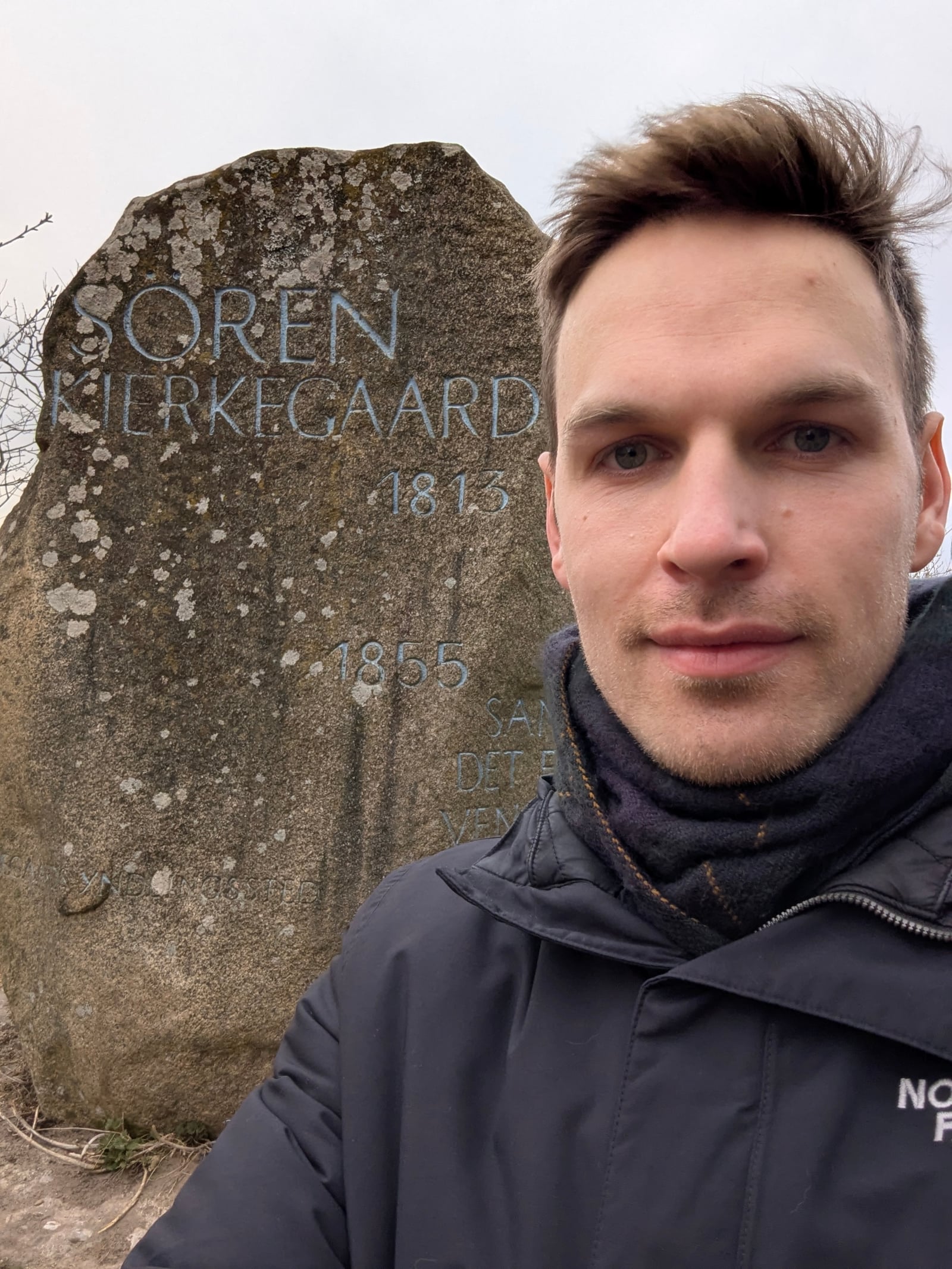
Even Kierkegaard, wandering in the labyrinth of sufferings, had moments when he stepped beyond the bounds of his convictions toward unconditional and self-sufficient happiness:
This pure being, the absence of any need or lack, the fullness and oneness that lie beyond human illusions, is unfolded by Kierkegaard in one of his later works, “The Lily of the Field and the Bird of the Air” (29). Written in the form of three discourses under his own name at the age of 36, it discloses in detail the state of unconditional joy and the way in which abiding in it is possible:
Usually a human being takes pride in the ability to speak — aloud or mentally. But all this activity of the mind becomes a screen between the human being and Reality. The activity of the mind is a form of absence. While speaking and thinking, we do not hear. While speaking and thinking, we are not here, we are not present. The lily neither speaks nor deliberates — and precisely for this reason it is present, it is in the here and now. But what is this here and now? It is that which exists in itself, prior to all concepts and representations; it is that which is — Being Itself. And when we are present in It in pure form — we experience unconditional joy and love, the state and essence of God.
Thus, joy is not merely an experience, it is an ontological category, it is a state of being! Of my being, if so I wish. For I myself choose what I am. Who I am. This is a question of pure self-determination.
Throughout all of human history I have defined myself as anything but divine: as separated from Life, weak, deficient, incomplete, and condemned, cut off from inner wisdom and from my own truth, forced to rely on external authorities: religions, governments, scientists, and philosophers. And now comes the moment of awakening. The moment when I am capable of seeing my own illusions and stepping beyond their limits. The moment when each of us begins to ask oneself the principal question: Who am I?
References
-
“Our life is what our thoughts make it” — Marcus Aurelius. “Meditations” (To Himself), Book 4.3.
“People are disturbed not by things, but by their views about them” — Epictetus. “Enchiridion” (The Manual), Chapter 5.
“Mind precedes all mental states. Mind is their chief; they are all mind-wrought. If with an impure mind a person speaks or acts, suffering follows him like the wheel that follows the foot of the ox” — Buddha. “Dhammapada”, Chapter 1.
-
“The psychological rule says that when an inner situation is not made conscious, it happens outside as fate. That is to say, when the individual remains undivided and does not become conscious of his inner contradictions, the world must perforce act out the conflict and be torn into opposite halves” — C. G. Jung. “Aion: Researches into the Phenomenology of the Self”, 1951, CW 9ii, §126.
“Man’s main task in life is to give birth to himself, to become what he potentially is. The most important product of his effort is his own personality” — Erich Fromm. “Man for Himself”, 1947, ch. 4 “Problems of Humanistic Ethics”.
“Don’t bother about freedom. First, see that you are in prison: a prison social, economic, political, religious, a prison which you have created out of your own desires, ambitions, fears, and pleasures. When you understand your prison… then out of that comes freedom” — J. Krishnamurti. From talks published on jkrishnamurti.org (“Don’t bother about freedom. First, see that you are in prison…”).
“Everything can be taken from a man but one thing: the last of the human freedoms—to choose one’s attitude in any given set of circumstances, to choose one’s own way” — Viktor Frankl. “Man’s Search for Meaning”.
-
“Where there is pain, healing comes; where there is wretchedness, water comes. If you want water, find thirst, so that water may gush forth from above and below” — Jalal ad-Din Rumi. “Masnavi-i Ma’navi”, Book 3.
-
“There is no worse sickness for the soul, O proud one, than this pretense of perfection. The heart and eyes must bleed long before self-complacency falls away” — Jalal ad-Din Rumi. “Masnavi-i Ma’navi”, Book 1.
“God turns you from one feeling to another and teaches by means of opposites, so that you will have two wings to fly, not one” — Jalal ad-Din Rumi. “Masnavi-i Ma’navi”, Book 2.
-
“Man is a being whose being consists in being a question to itself”.
“Only in silence does conscience call; that is, the call comes from the soundlessness of the uncanny [Unheimlichkeit], and the Dasein it addresses is summoned by this call back into the stillness of itself” — Martin Heidegger. “Being and Time”, 1927.
“Aham (‘I’) is known to everyone. Brahman abides as Aham in everyone. Find out the ‘I’. The ‘I’ is already Brahman.” — Sri Ramana Maharshi. Talks with Sri Ramana Maharshi.
-
“The essence of man rests in the fact that he is claimed by Being and destined to be its guardian” — Martin Heidegger. “Letter on Humanism”, 1947.
“The thirsty one moans: ‘O most delicious water!’ The water cries: ‘Where is the one who will drink me?’ The thirst in our souls is the magnetism of the Water: We are It, and It is us” — Jalal ad-Din Rumi. “Diwan-i Shams-i Tabrizi”.
“I am Brahman” (Aham Brahmāsmi) — Brihadāraṇyaka Upaniṣad, 1.4.10.
“Thou art That” (Tat tvam asi) — Chāndogya Upaniṣad, 6.8.7.
-
I later encountered a reflection of some of my own experiences in the Gospel of Thomas: “Let him who seeks not cease seeking until he finds, and when he finds, he will be troubled, and when he is troubled, he will marvel, and he will reign over all” — Gospel of Thomas, logion 2.
-
“The kingdom of God cometh not with observation: Neither shall they say, Lo here! or, lo there! for, behold, the kingdom of God is within you” — Luke 17:20–21.
And also: “If those who lead you say to you: ‘See, the kingdom is in heaven,’ then the birds of heaven will precede you. If they say to you: ‘It is in the sea,’ then the fish will precede you. But the kingdom is within you and outside you” — Gospel of Thomas, logion 3.
“When you bring forth that within yourselves, that which you have will save you. If you do not have that within yourselves, that which you do not have within you will kill you” — Gospel of Thomas, logion 70.
“The ‘I am’ is the door. Stay at it until it opens. As a matter of fact, it is open, only you are not at it.” — Sri Nisargadatta Maharaj. I Am That.
“Know thyself, and thou shalt know the gods and the Universe” — Maxim of the Seven Sages, inscribed on the Temple of Apollo at Delphi.
-
The principle of qualitative transition, the leap between stages of existence, is described in detail in “Concluding Unscientific Postscript to the Philosophical Crumbs” (1846) — Søren Kierkegaard.
-
My spiritual path resonates with that described by the 16th-century Spanish mystic John of the Cross in his treatises “The Ascent of Mount Carmel” and “The Dark Night of the Soul”.
-
“And God created man in his own image, in the image of God created he him” — Genesis 1:26–27.
-
“Do not accept anything on faith merely because: it is said by tradition or sacred scripture; it seems logical or plausible; it is taught by your teacher. But when you yourselves know through your own experience that these things are noble, approved by the wise, and lead to good and happiness — then accept them and follow them” — Buddha. “Kalama Sutta”.
“Faith is only the seed; the fruit is direct knowledge gained through personal experience and meditation” — Buddha.
-
As an analytical framework, applied to myself and Kierkegaard, I used the typology described in “Communion with God” — Neale Donald Walsch.
-
The aesthetic stage. “Either/Or” (Enten — Eller). Part I, 1843; “Stages on Life’s Way” (Stadier paa Livets Vei), 1845 — Søren Kierkegaard.
-
The ethical stage. “Either/Or” (Enten — Eller), 1843. Part II; “Stages on Life’s Way” (Stadier paa Livets Vei), 1845 — Søren Kierkegaard.
-
The religious stage. “Fear and Trembling” (Frygt og Bæven), 1843 — Søren Kierkegaard (under the pseudonym Johannes de Silentio).
“Concluding Unscientific Postscript to the Philosophical Crumbs” (Afsluttende uvidenskabelig Efterskrift), 1846 — Søren Kierkegaard (under the pseudonym Johannes Climacus).
“The Sickness Unto Death” (Sygdommen til Døden), 1849 — Søren Kierkegaard (under the pseudonym Anti-Climacus).
-
“Look within. Within is the fountain of good, which will ever bubble up if thou wilt ever dig” — Marcus Aurelius. “Meditations”, Book 7.59.
-
Primary consciousness. The broadest self-identification God uses in his communication with Moses: “I AM THAT I AM” — Exodus 3:14.
“‘I am’ is the name of God. Of all the definitions of God, none is so well put as the biblical statement ‘I AM THAT I AM’ in Exodus chapter three. There are other statements such as Aham Brahmāsmi and Soham, but none is so direct as Jehovah — ‘I AM’.” — Sri Ramana Maharshi. Talks with Sri Ramana Maharshi, Talk 106.
The same thing, but in a non-theological aspect, is veiledly described by Heidegger: “Simplicity preserves within itself the riddle of what abides and is great. Without delay it descends to people, but it requires long maturation” — Martin Heidegger. “The Pathway”, 1949.
“To dwell [wohnen], to be at peace, means to remain in the world, in the free expanse that protects each thing in its own essence. The fundamental character of dwelling is preservation and safekeeping” — Martin Heidegger. “Building, Dwelling, Thinking”, 1951.
I saw that pure non-substantial I-am-ness is precisely that fullness of presence to which Heidegger referred; he further explains: “To think means to attend to the presence of what is present: to let what lies before us in the world lie before us, and at the same time to take it to heart — to preserve it in the one place where it is safely preserved: in the thinking of our own being” — Martin Heidegger. “What Is Called Thinking?”, 1952.
“We must let things be in repose, in their own essence… This state we call releasement (Gelassenheit) toward things” — Martin Heidegger. “Releasement”, 1955.
It is curious that Heidegger essentially retells the Catholic mystic Meister Eckhart in non-theological language: “To be full of things is to be empty of God; to be empty of things is to be full of God” — Meister Eckhart. “Spiritual Sermons and Discourses”.
-
Belief in death is possible only with belief in separateness, for only then does a separate finite “I” arise: “Look upon the world as empty. Ever mindful, having destroyed the view of self, you can overcome death. The one who looks upon the world thus is not seen by the King of Death” — Buddha. “Sutta Nipata”, 1119.
-
“[A man said] to him: ‘Tell my brothers to divide my father’s possessions with me.’ He said to him: ‘O man, who has made me a divider?’ He turned to his disciples and said to them: ‘I am not a divider, am I?’” — Gospel of Thomas, logion 72.
-
Such an experience is the very essence of being of which Heidegger speaks: “The world becomes an object, and man becomes the subject who represents and orders this world. But in this ordering, the very essence of being is forgotten” — Martin Heidegger. “The Age of the World Picture”, 1938.
-
Besides being the heart of Eastern philosophy, awareness of divine oneness is found numerous times in Christian sources as well: “I am the light that is over all things. I am all: from me all came forth, and to me all attained. Split a piece of wood, and I am there. Lift up the stone, and you will find me there” — Gospel of Thomas, logion 77.
“He who drinks from my mouth will become like me. I myself shall become him, and the hidden things will be revealed to him” — Gospel of Thomas, logion 108.
“I and my Father are one <…> The Jews answered him, saying, For a good work we stone thee not; but for blasphemy; and because that thou, being a man, makest thyself God <…> Jesus answered them, Is it not written in your law, I said, Ye are gods?” — John 10:30–34.
“That they all may be one; as thou, Father, art in me, and I in thee, that they also may be one in us” — John 17:21.
“…for I was an hungred, and ye gave me meat: I was thirsty, and ye gave me drink: I was a stranger, and ye took me in: Naked, and ye clothed me: I was sick, and ye visited me: I was in prison, and ye came unto me <…> Verily I say unto you, Inasmuch as ye have done it unto one of the least of these my brethren, ye have done it unto me” — Matthew 25:35–40.
“For as the body is one, and hath many members, and all the members of that one body, being many, are one body: so also is Christ” — 1 Corinthians 12:12–14.
“There is neither Jew nor Greek, there is neither bond nor free, there is neither male nor female: for ye are all one in Christ Jesus” — Galatians 3:28.
“When you make the two one, you will become the Son of Man, and if you say to the mountain, ‘Move,’ it will move” — Gospel of Thomas, logion 106.
And the same is found in Islamic mysticism: “I am truthful, I am a liar — all are equal; sometimes I am a fair Arab, sometimes black-faced — all are equal. I am storm and dust, water and fire, sometimes I pass for noble, sometimes for villain — all are equal” — Jalal ad-Din Rumi. “Diwan-i Shams-i Tabrizi”.
And among the Stoics: “All things are interwoven with one another, and the bond is sacred… For there is one universe out of all things, and one God in all things, and one substance, and one law” — Marcus Aurelius. “Meditations”, Book 7.9.
-
“It is not the man who has too little who is poor, but the one who craves more” — Seneca. “Moral Letters to Lucilius”, Letter 2.
“Frugality in itself is great wealth” — Seneca.
“The greatest wealth is the absence of strong desires” — Epictetus. “Discourses”.
“Nothing is enough for him to whom enough is too little” — Epicurus. “Vatican Sayings”, 68.
-
Buddha expressed this beautifully in the sutras: “Even if a person has very little left, even if he himself is in need, he should still give. For giving in need is what brings the greatest fruit” — Buddha. “Samyutta Nikaya”, 1.32.
“If beings knew, as I know, the fruit of giving and sharing, they would not eat without sharing, and the stain of stinginess would not take hold of their minds. Even if it were their last morsel, their last sip — they would not eat without sharing with one ready to receive” — Buddha. “Itivuttaka”, 26.
-
“Judge not, that ye be not judged. For with what judgment ye judge, ye shall be judged: and with what measure ye mete, it shall be measured to you again” — Matthew 7:1–2.
“Thou shalt love thy neighbour as thyself” — Matthew 22:39; Mark 12:31; Luke 10:27.
-
“And why beholdest thou the mote that is in thy brother’s eye, but considerest not the beam that is in thine own eye? <…> Thou hypocrite! first cast out the beam out of thine own eye; and then shalt thou see clearly to cast out the mote out of thy brother’s eye” — Matthew 7:3–5; Luke 6:41–42.
“The faults of others are easily seen, but one’s own faults are hard to see. A man winnows the faults of others like chaff, but conceals his own as a skilled gambler hides a losing throw” — Buddha. “Dhammapada”, 252.
-
“I know only that I know nothing, but others do not even know that” — Socrates. “Apology of Socrates”.
-
“But ye have an unction from the Holy One, and ye know all things… and ye need not that any man teach you” — 1 John 2:20, 27.
“…I will put my law in their inward parts, and write it in their hearts… And they shall teach no more every man his neighbour, and every man his brother, saying, Know the Lord: for they shall all know me…” — Jeremiah 31:33–34.
“Therefore, Ananda, be a lamp unto yourselves, be a refuge unto yourselves, and seek no other refuge; let the Dhamma (Truth) be your lamp, let the Dhamma be your refuge, and seek no other refuge” — Buddha. “Mahaparinibbana Sutta”.
-
“The Lily of the Field and the Bird of the Air” — Søren Kierkegaard. The title of the work and a direct reference to the Sermon on the Mount (Matthew 6:26–28).